What makes industrial paving different from a parking lot
A customer parking lot sees cars spread across the whole surface. An industrial yard sees heavy trucks following the same path every day, stopping and starting in the same spots, and turning tight with loaded trailers. Those wheel paths, turns, and stopping points take the beating, and that is where yards fail first.
There are also loads a parking lot never sees: trailers parked on their landing gear, forklifts, loaders, and equipment sitting for weeks on outriggers or steel tracks. Each of those presses a lot of weight into a small area.
That is why we design a yard by zones instead of one thickness everywhere. For customer and employee lots, our parking lot paving page covers that work.
Sizing heavy-duty pavement to the loads
The base and asphalt have to match what runs on them. Building every square foot to the heaviest load wastes money. Building to a car's load in a truck lane fails early. So we zone the site: truck lanes and turning areas, dock approaches, trailer parking, equipment storage, and car parking each get the section they need, spec'd per job.
To get that right, we need to know how the site works. Tell us the kinds of vehicles that use it, roughly how many trucks come through, where they turn and wait, and what equipment sits on the pavement.
The soil matters as much as the asphalt. Much of central Mississippi sits on clay that loses strength when it stays wet, and a heavy wheel on a soft base makes ruts quickly. Drainage and a well-compacted crushed limestone base do most of the work.
Loading docks, aprons, and where concrete makes sense
The area in front of a dock is the hardest-working pavement on most sites. Trucks back in, stop, and pull out in the same tracks, and docks are often the low point where water collects. Asphalt there can be built heavier, but in some spots concrete is the better answer.
Concrete pads make sense where trailers sit on landing gear, where heavy equipment turns in place, and at fueling or service areas where spills are common. Asphalt still makes sense for the long runs and open yard, where it costs less and is quicker to repair.
We pour concrete in-house, so one company handles both surfaces and the joint between them. See our concrete services for that side of the work.
Common heavy-duty pavement problems and the fix
Most industrial pavement failures trace back to load, water, or both.
- Ruts in the wheel paths mean the base or asphalt is too light for the traffic, or the base is wet. The fix is rebuilding that lane to a heavier section, with drainage corrected.
- Alligator cracking at docks and turns means the base has failed under repeated loads. It has to be cut out and rebuilt.
- Potholes at drains and low spots come from standing water. Regrading so water leaves the pavement stops them from returning.
- Shoving and ripples at turns and stops come from heavy wheels braking and turning on a soft surface.
- Soft, crumbling spots at fuel and service areas come from spills softening the asphalt.
For localized damage, our parking lot repair work covers cut-out and rebuild patches.
Paving an active yard without shutting it down
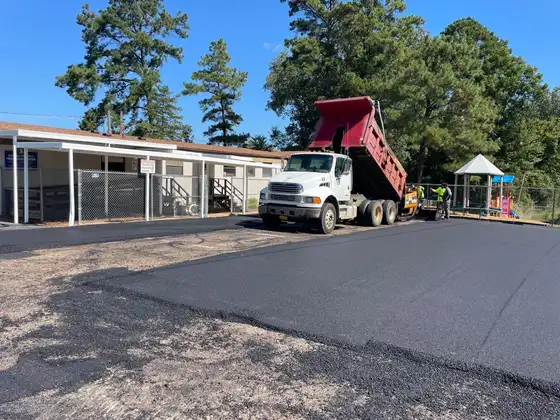
Most yards cannot close. We plan the job in phases so the site keeps working: one lane or zone at a time, with a clear route around the work and at least one gate and enough docks open each day.
Before we start, we sit down with whoever runs the yard and agree on the sequence, which areas close when, and where trucks will stage. Fresh asphalt is ready for light vehicles in about 24 hours and heavy trucks in 48 to 72 hours, and the plan has to allow for that before each zone reopens.
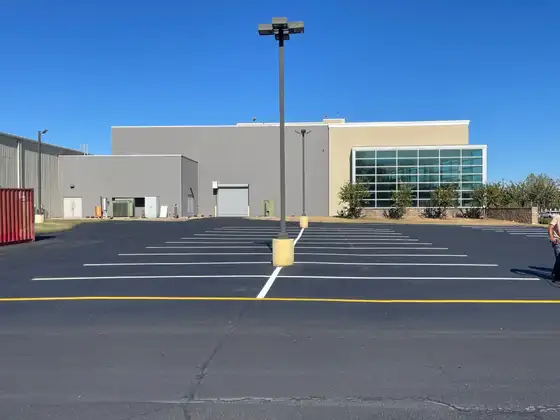
Lane striping, arrows, and other markings are done by our own employees, so the yard does not wait on a second contractor to be usable again.
What drives the cost of industrial paving
Industrial jobs vary more than any other paving work, so the quote starts with the site walk. The main factors:
- The heaviest vehicles and how many come through, which set the pavement design.
- How much area falls in each zone, from truck lanes to car parking.
- Base condition, and how much failed material has to come out.
- Grading and drainage corrections.
- Phasing and working around your operations.
- Concrete pads, striping, and markings.
The best ways to control cost are to put the heavy section only where loads need it, fix drainage as part of the job, and repair local failures before they spread. Your quote is written, itemized, and free, with no hidden fees.